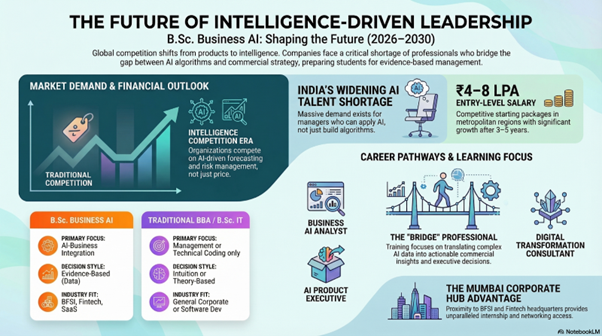
Between 2026 and 2030, organisations will not compete only on products or pricing — they will compete on intelligence. AI-driven business transformation is reshaping how companies forecast demand, manage risk, personalise customer journeys, and optimise internal processes.
Across sectors, companies are seeking professionals who understand both commercial strategy and artificial intelligence. This has created strong corporate demand for AI-enabled managers who can translate data into decisions rather than just build algorithms.
At the same time, India faces a widening AI talent shortage. Industry reports consistently indicate that while AI adoption is increasing, trained professionals who can apply AI in real business environments remain limited. Degrees that combine business acumen with AI capability are therefore emerging as strategic undergraduate pathways.
Table of Contents
9 sections — ~10 min read- 01Future of AI in Business: Why This Degree Matters
- 02What You Will Learn in B.Sc. Business AI
- 03Career Opportunities After B.Sc. Business AI
- 04Salary Scope of B.Sc. Business AI in India
- 05Why Mumbai & Navi Mumbai Are Ideal for Business AI Careers
- 06Eligibility & Admission Process for B.Sc. Business AI
- 07Why Choose HBSU NewGen for B.Sc. Business AI
- 08Conclusion: Is B.Sc. Business AI Worth It for the Future?
- 09Frequently Asked Questions
Key Insight: AI literacy is not about learning to code in isolation. It is about understanding how AI reshapes industries, informs decisions, and creates new professional responsibilities — and being equipped to navigate all three.
Future of AI in Business: Why This Degree Matters
The future of AI in business is no longer theoretical. AI systems are already influencing boardroom decisions, pricing models, and customer engagement strategies.
- AI in decision-making: Companies now rely on real-time dashboards, forecasting models, and AI-powered insights to guide executive strategy.
- Automation in marketing, finance & operations: From automated campaign optimisation to fraud detection and supply chain planning, AI reduces manual intervention while increasing efficiency.
- Predictive analytics for business growth: AI tools help businesses anticipate customer behaviour, forecast revenue, and identify growth opportunities before competitors.
A Business AI degree prepares students not merely to understand these systems but to manage and implement them effectively.
What You Will Learn in B.Sc. Business AI
A B.Sc. Business AI program is designed to create professionals who understand both the language of data and the logic of business. It does not treat artificial intelligence as an isolated technical subject; instead, it integrates analytics, decision science, and managerial strategy into one cohesive academic structure. Students are trained to interpret numbers within a commercial context and apply technology to real organisational challenges.
Business Analytics
Students begin by developing the ability to interpret structured and unstructured data drawn from business environments. This includes analysing sales trends, customer behaviour, financial performance indicators, and operational efficiency metrics. Through case-based learning, they understand how raw data is transformed into meaningful insights that guide executive decisions. Business analytics modules strengthen statistical reasoning and improve the ability to identify patterns that influence profitability and growth.
Artificial Intelligence Fundamentals
The programme introduces foundational AI concepts such as algorithms, supervised and unsupervised learning, neural networks, and intelligent systems. Rather than focusing solely on coding complexity, students learn how AI frameworks operate and how they are deployed in business ecosystems. This builds conceptual clarity, allowing learners to understand automation, predictive modelling, and decision-support systems used across industries.
Machine Learning for Business
Machine learning in this programme is applied rather than purely theoretical. Students study how predictive models can forecast demand, detect fraud, personalise marketing campaigns, or optimise pricing strategies. The emphasis remains on solving commercial problems rather than developing standalone technical prototypes. By the end of the course, students understand how machine learning enhances competitiveness and operational efficiency.
Data-driven Management
One of the most critical shifts in modern organisations is the transition from intuition-based leadership to evidence-based management. Students explore how companies build performance dashboards, key performance indicators (KPIs), and predictive systems that guide strategic planning. They learn how executives interpret analytics reports and integrate insights into long-term business decisions. This area bridges the gap between data teams and management leadership.
AI Tools for Marketing & Finance
Practical exposure forms a core part of the curriculum. Students work with analytics dashboards, forecasting software, and optimisation tools used in marketing and financial planning. They explore customer segmentation models, risk assessment systems, and ROI measurement frameworks. This hands-on learning ensures familiarity with real-world platforms commonly used in corporate environments.
The interdisciplinary nature of the programme ensures that graduates are not limited to theoretical knowledge. Instead, they emerge with analytical fluency, commercial awareness, and practical familiarity with AI-driven systems used across industries.
Key Insight: Neither degree is superior in absolute terms. The right choice depends on whether you see yourself driving AI strategy in a business setting or building AI systems from the ground up. For students who want to work at the intersection of technology and industry, Business AI is purpose-built for that path.
Career Opportunities After B.Sc. Business AI
The demand for professionals trained in Business AI is expanding rapidly as organisations across sectors adopt data-centric strategies. Companies now require individuals who can interpret AI outputs, communicate insights clearly, and align technological systems with business objectives.
🔹 Business AI Analyst
A Business AI Analyst acts as a bridge between technical teams and management. They interpret AI-generated insights and translate them into strategic recommendations for leadership. This role demands analytical capability along with communication clarity, ensuring that complex models produce actionable outcomes.
🔹 Data Analyst
Data Analysts work with structured business datasets to extract patterns, monitor performance metrics, and generate reports for decision-making teams. They play a foundational role in analytics-driven companies by maintaining data integrity and ensuring accurate forecasting. This role often serves as a gateway into advanced analytics positions.
🔹 AI Product Executive
An AI Product Executive supports the design, testing, and deployment of AI-enabled products. Whether in fintech, retail technology, or digital platforms, this role involves coordinating between product developers and business strategists. Professionals in this position ensure that AI solutions align with customer needs and market demand.
🔹 Digital Transformation Consultant
Digital Transformation Consultants advise organisations on how to integrate AI tools into existing workflows. They evaluate operational inefficiencies, recommend automation strategies, and oversee implementation processes. This role is highly visible in consulting firms and enterprises undergoing technological modernisation.
🔹 Business Intelligence Analyst
Business Intelligence Analysts design dashboards, reporting frameworks, and visual performance tracking systems for leadership teams. They ensure that executives receive clear, data-backed summaries to guide operational and financial planning. This role combines technical dashboard development with strategic interpretation.
These roles are increasingly visible across Banking, Financial Services and Insurance (BFSI), consulting, e-commerce, IT services, retail analytics, and media sectors. As AI adoption becomes mainstream, the relevance of such positions continues to grow.
Key Insight: These roles exist across every major sector — banking, e-commerce, healthcare, logistics, and media. Graduates are not locked into one industry; they are equipped to move across them.
Salary Scope of B.Sc. Business AI in India
The salary trajectory depends on skills, internship exposure, and technical proficiency.
Freshers Salary
Entry-level roles in analytics and AI-supported domains typically range between ₹4–8 LPA in metropolitan regions.
Growth After Experience
With 3–5 years of experience, professionals often transition into senior analytics or AI strategy roles with significant salary progression.
Mumbai & Navi Mumbai Salary Trends
Given the density of financial institutions, IT companies, and startups, salary bands in Mumbai and Navi Mumbai tend to remain competitive compared to other regions.
Long-term growth depends more on capability and industry exposure than on degree title alone.
Connect with us to build a clear and confident career direction
Get in TouchKey Insight: The blended format is not a shortcut — it is a structured path that mirrors how modern professionals actually work. It builds academic knowledge, digital fluency, and workplace readiness simultaneously.
Why Mumbai & Navi Mumbai Are Ideal for Business AI Careers
Mumbai's corporate infrastructure creates a strong ecosystem for Business AI professionals. As India's financial capital, the city hosts the headquarters of major banks, consulting firms, insurance companies, and multinational corporations. These organisations actively invest in AI-based decision systems for fraud detection, risk modelling, marketing analytics, and operational forecasting.
The startup ecosystem in Navi Mumbai and the surrounding regions is equally dynamic. Emerging fintech companies, SaaS platforms, and analytics-driven enterprises are adopting AI-first business models. This creates demand for graduates who understand both business logic and technical implementation.
Additionally, sectors such as BFSI, IT services, and analytics are among the largest adopters of AI-enabled systems. For students, studying in proximity to such ecosystems enhances internship access, networking opportunities, and early-career placements. Exposure to real corporate environments strengthens employability and accelerates professional growth.
Key Insight: You do not need to be in Bangalore or Pune to build a career in AI. Mumbai and Navi Mumbai are among the most active hiring markets for AI-adjacent roles in India today.
Eligibility & Admission Process for B.Sc. Business AI
After 12th Eligibility
Students who have completed Class 12 from recognised boards are generally eligible. Backgrounds in commerce, science, or mathematics are advantageous.
Documents Required
Typical requirements include academic transcripts, identity proof, passport-sized photographs, and entrance or merit-based evaluation documents.
Application Steps
Institutions usually follow an online application process involving form submission, document verification, and admission confirmation.
Key Insight: If your child has cleared 10+2 with 50% marks — regardless of their stream — they are eligible to apply. The program is built for motivated learners, not just those with a science background.
Why Choose HBSU NewGen for B.Sc. Business AI
HBSU NewGen structures its Business AI programme around current industry adoption trends rather than outdated theoretical frameworks. The curriculum is designed to reflect how organisations are using AI today—in finance, marketing, supply chain optimisation, and digital transformation.
The emphasis remains on business-focused AI learning. Students are trained to apply AI systems to commercial challenges instead of limiting their understanding to technical coding exercises. This ensures they grasp both technological mechanisms and enterprise objectives.
Practical exposure is integrated through structured internships and industry interaction. Learners gain first-hand experience observing AI-driven workflows in corporate settings, improving their confidence and readiness for employment. This combination of technical grounding and industry immersion prepares graduates to operate effectively within modern business ecosystems.
Key Insight: Program fees should be evaluated in the context of outcomes, not in isolation. A degree that places you in AI-adjacent roles within a growing sector is an investment with measurable returns.
Conclusion: Is B.Sc. Business AI Worth It for the Future?
Artificial intelligence is no longer a specialised or optional skill set confined to technology firms. It has become a foundational component of management, finance, marketing, operations, and strategic planning across industries.
A Business AI degree offers students exposure to emerging AI applications while simultaneously building cross-functional commercial understanding. It prepares graduates for high-growth analytics and strategy roles that are expected to expand significantly between 2026 and 2030.
More importantly, it provides long-term adaptability in industries that are continuously evolving under digital transformation. For students seeking a future-ready career path that aligns with global industry direction, B.Sc. Business AI stands out as a strategically relevant and forward-looking choice.