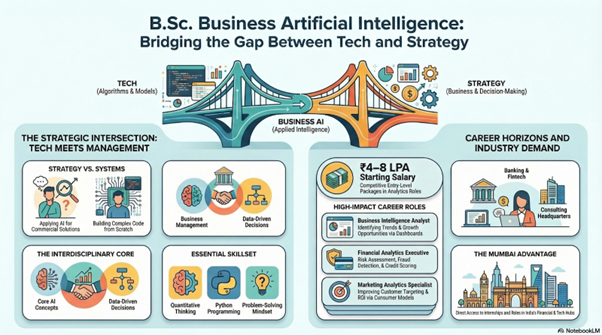
Businesses are no longer driven by instinct alone. From retail pricing and supply chain forecasting to digital marketing and financial risk assessment, decisions today are powered by algorithms, predictive models, and real-time analytics. This transformation has turned AI-driven strategy into a high demand course area for students who want to enter the modern corporate world.
Commerce students, science students, and learners with mathematics backgrounds can adapt well to this programme. What matters most is the willingness to develop analytical discipline, comfort with structured thinking, and curiosity about how businesses operate using data-driven systems.
Table of Contents
9 sections — ~10 min read- 01How Business AI Is Changing the Corporate Landscape
- 02Why AI for Business Is Different from Traditional Tech Degrees
- 03Understanding B.Sc Artificial Intelligence vs Business-Focused AI
- 04Why AI University Courses Are Expanding Rapidly
- 05The Future of AI in Business
- 06What to Prepare for in a B.Sc Business AI Programme
- 07Career Opportunities After B.Sc Business AI
- 08Is This Course Suitable for Commerce Students?
- 09Frequently Asked Questions
Key Insight: AI literacy is not about learning to code in isolation. It is about understanding how AI reshapes industries, informs decisions, and creates new professional responsibilities — and being equipped to navigate all three.
How Business AI Is Changing the Corporate Landscape
The integration of business AI into daily operations has reshaped how organisations function. Companies now rely on AI systems to:
- Predict customer behaviour
- Automate repetitive workflows
- Detect fraud in financial transactions
- Personalise digital marketing campaigns
- Optimise logistics and inventory
AI is no longer limited to tech companies. Banking, consulting, healthcare, e-commerce, media, and manufacturing all depend on AI-backed decision-making.
Why AI for Business Is Different from Traditional Tech Degrees
Many students assume artificial intelligence is only for hardcore programmers. However, AI for business focuses on applying AI tools to solve commercial problems rather than building complex AI systems from scratch.
This means students learn:
- Data interpretation for managerial decisions
- AI-driven business analytics
- Automation strategy
- Consumer intelligence modelling
- Business forecasting using machine learning
The goal is not just coding expertise, but strategic application.
Key Insight: Neither degree is superior in absolute terms. The right choice depends on whether you see yourself driving AI strategy in a business setting or building AI systems from the ground up. For students who want to work at the intersection of technology and industry, Business AI is purpose-built for that path.
Understanding B.Sc Artificial Intelligence vs Business-Focused AI
A traditional BSc Artificial Intelligence programme emphasises algorithm design, neural networks, system architecture, and advanced programming. It prepares students for technical AI development roles.
In contrast, Business AI programmes combine:
- Core AI concepts
- Business management fundamentals
- Data-driven decision-making
- Industry use cases
Students graduate with both analytical capability and commercial understanding — a combination increasingly valued in the corporate ecosystem.
Key Insight: If your child has cleared 10+2 with 50% marks — regardless of their stream — they are eligible to apply. The program is built for motivated learners, not just those with a science background.
Why AI University Courses Are Expanding Rapidly
Across India, especially in financial and commercial hubs, AI university courses are expanding due to industry demand. Mumbai, being India's financial capital, presents unique opportunities:
- Headquarters of banks and fintech firms
- Growing startup ecosystem
- Media and entertainment analytics demand
- Corporate consulting firms
- E-commerce and retail giants
This environment creates practical exposure opportunities for students pursuing Business AI.
Speak with us to align your academic choices with your career goals
Get in TouchKey Insight: The blended format is not a shortcut — it is a structured path that mirrors how modern professionals actually work. It builds academic knowledge, digital fluency, and workplace readiness simultaneously.
The Future of AI in Business
The future of AI in business is not limited to automation. It includes strategic intelligence.
Over the next decade, organisations will increasingly depend on:
- AI-powered executive dashboards
- Predictive revenue models
- Customer lifetime value analytics
- AI-led supply chain automation
- Intelligent financial planning systems
Business leaders who understand AI logic will hold a competitive advantage. This is why undergraduate exposure to AI in commercial contexts is becoming strategically important.
Key Insight: These roles exist across every major sector — banking, e-commerce, healthcare, logistics, and media. Graduates are not locked into one industry; they are equipped to move across them.
What to Prepare for in a B.Sc Business AI Programme
A B.Sc Business AI programme is not purely technical and not purely managerial — it sits at the intersection of data science and business decision-making. Students entering this field should be prepared to build both analytical competence and strategic understanding. The course demands structured thinking, comfort with numbers, and the ability to translate insights into practical business actions.
Students should prepare for the following dimensions:
1. Quantitative Thinking
A strong foundation in mathematics and statistics is essential. Topics such as probability, linear algebra, basic calculus, and statistical inference help students understand how algorithms function and how predictive models are built. Logical reasoning is equally important because AI systems rely on structured problem-solving approaches.
Quantitative thinking in this programme is not about solving complex theoretical equations alone — it is about understanding patterns in data, measuring business performance, and evaluating outcomes using measurable indicators.
2. Analytical Software Skills
Students are introduced to practical tools that are widely used in corporate environments. Programming languages like Python are used for data cleaning, modelling, and machine learning tasks. Excel modelling strengthens financial and operational analysis, while Business Intelligence (BI) dashboards help visualise trends and performance indicators.
Learning how to use data visualisation platforms such as Power BI or Tableau helps students convert raw numbers into actionable insights. The ability to work comfortably with software tools ensures that graduates are industry-ready rather than purely theoretical learners.
3. Business Fundamentals
Since this is a business-focused AI programme, students must understand core management concepts. Subjects such as marketing analytics, financial analysis, operations management, and strategic decision-making are integrated with AI applications.
For example:
- AI in marketing helps improve customer targeting.
- AI in finance supports fraud detection and risk prediction.
- AI in operations enhances demand forecasting and supply chain optimisation.
Understanding business fundamentals ensures that students do not just build models — they understand why those models matter.
4. Problem-Solving Orientation
Perhaps the most important preparation is developing a problem-solving mindset. Students must learn how to:
- Identify business problems clearly
- Frame them in analytical terms
- Use data to test hypotheses
- Interpret results in a decision-making context
AI is not about technology alone; it is about applying technology to solve real organisational challenges. Graduates who can convert data insights into strategic recommendations stand out in the job market.
Key Insight: Becoming an AI professional is a progression, not a single leap. This program is designed to start that journey with the right academic and practical foundation, regardless of your school background.
Career Opportunities After B.Sc Business AI
The career landscape after completing this degree is diverse and expanding. As organisations increasingly depend on data-driven decisions, professionals who understand both AI systems and business strategy are in strong demand.
Graduates can explore the following roles:
🔹 Business Intelligence Analyst
A Business Intelligence Analyst works with organisational data to identify trends, performance gaps, and growth opportunities. They design dashboards and reporting systems that help management teams make informed strategic decisions. This role requires both technical data handling skills and an understanding of corporate objectives.
🔹 Data Analyst
Data Analysts collect, organise, and interpret structured datasets to support managerial planning. They use statistical tools and software to identify patterns in sales, operations, finance, or customer behaviour. This role acts as the backbone of data-driven companies, ensuring decisions are supported by measurable evidence.
🔹 AI Strategy Associate
An AI Strategy Associate helps organisations integrate AI-based tools into existing business processes. This role involves evaluating automation opportunities, recommending AI adoption strategies, and coordinating between technical teams and management. It is particularly relevant in consulting firms and technology-driven enterprises.
🔹 Financial Analytics Executive
This role combines finance with predictive modelling. Professionals analyse investment risks, credit scoring systems, fraud detection mechanisms, and financial forecasting models. By applying machine learning techniques to financial data, they improve accuracy in decision-making and risk assessment.
🔹 Marketing Analytics Specialist
Marketing Analytics Specialists use AI models to study customer segmentation, campaign performance, pricing strategies, and consumer behaviour patterns. They work closely with marketing teams to improve targeting efficiency and return on investment. This role is highly relevant in e-commerce, fintech, and digital marketing sectors.
🔹 Operations Analyst
Operations Analysts apply AI-based forecasting systems to optimise supply chains, inventory levels, and logistics networks. By analysing historical trends and predictive demand patterns, they help organisations reduce costs and improve efficiency. This role is critical in manufacturing, retail, and distribution industries.
Mumbai and Navi Mumbai serve as major hubs for corporations, fintech startups, consulting firms, analytics companies, and technology service providers. The presence of financial institutions, multinational companies, and emerging digital enterprises makes the region particularly favourable for graduates in Business AI. Students in this geography gain exposure to internships, networking opportunities, and entry-level roles aligned with analytics and AI-driven business functions.
Key Insight: Program fees should be evaluated in the context of outcomes, not in isolation. A degree that places you in AI-adjacent roles within a growing sector is an investment with measurable returns.
Is This Course Suitable for Commerce Students?
Yes. Students from commerce backgrounds often bring:
- Financial literacy
- Business understanding
- Economic reasoning
When combined with AI training, this creates a powerful skill set that bridges data and decision-making.
Salary Expectations After B.Sc Business AI
Entry-level salaries vary based on skill level and company type. In metropolitan regions like Mumbai:
- Freshers in analytics roles may start between ₹4–8 LPA
- Strong technical plus business profiles can command higher packages
- With 3–5 years of experience, professionals often move into strategic or managerial analytics roles
Long-term growth depends more on skill depth than just a degree title.
Key Insight: You do not need to be in Bangalore or Pune to build a career in AI. Mumbai and Navi Mumbai are among the most active hiring markets for AI-adjacent roles in India today.
Frequently Asked Questions
Is B.Sc. Business Artificial Intelligence a high-demand course?
What is the future of AI in business?
Is B.Sc. Business AI better than B.Sc Artificial Intelligence?
What jobs can I get after a B.Sc. Business AI?
Is this course suitable for commerce students?
Is B.Sc. Business AI available in Mumbai or Navi Mumbai?
Conclusion
The growing integration of artificial intelligence into business functions has transformed the expectations placed on graduates entering the workforce. A B.Sc. in Business Artificial Intelligence responds directly to this shift by combining technological competence with strategic business understanding. In Mumbai's dynamic economic landscape, where finance, retail, logistics, and digital enterprises intersect, professionals who can interpret AI insights within business contexts are increasingly valuable. As AI continues to redefine competitive advantage, students who prepare early through structured, interdisciplinary education position themselves not merely for jobs, but for adaptable, future-oriented careers in an AI-driven economy.