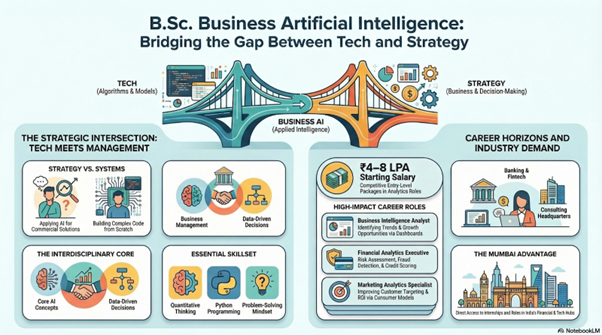
The conversation around the artificial intelligence course in Mumbai has shifted from niche curiosity to urgent necessity. Employers across banking, healthcare, retail, logistics, and technology are no longer treating AI as a technical add-on — they expect graduates to understand how it works, where it applies, and how to use it responsibly. AI literacy is no longer a differentiator; it is a baseline expectation.
This shift is particularly visible in Mumbai and Navi Mumbai, where the concentration of startups, financial institutions, and global MNCs has created a talent gap between what graduates know and what organisations need. Students who enter the workforce with a structured understanding of AI — not just as users, but as informed practitioners — are far better positioned to grow into roles that drive business decisions.
Table of Contents
9 sections — ~10 min read- 01What Makes a Business AI Degree Different from a Conventional Tech Degree
- 02B.Sc. Business AI vs. B.Sc. Computer Science — A Direct Comparison
- 03Who Can Pursue This — And Why the Eligibility Is Broader Than You Think
- 04The Learning Experience: Where the Classroom Meets the Industry
- 05What You Will Learn, The Skills You Will Build, and Where You Can Go
- 06How to Become an AI Engineer or AI Professional After 12th
- 07Understanding the Investment: Fees and What They Cover
- 08AI Careers and Opportunities in Mumbai and Navi Mumbai
- 09Frequently Asked Questions
Key Insight: AI literacy is not about learning to code in isolation. It is about understanding how AI reshapes industries, informs decisions, and creates new professional responsibilities — and being equipped to navigate all three.
What Makes a Business AI Degree Different from a Conventional Tech Degree
A common question students and parents raise is whether a B.Sc Business AI degree holds the same weight as a traditional Computer Science degree. The honest answer is that they serve different purposes — and for many career paths, Business AI is the more relevant choice.
Where a conventional CS degree goes deep into systems architecture and programming theory, a Business AI degree is built around applications. It trains students to understand AI tools, interpret their outputs, and apply that knowledge within real business functions — strategy, operations, marketing, and finance. This makes the graduate versatile across industries rather than siloed into a purely technical role.
B.Sc. Business AI vs. B.Sc. Computer Science — A Direct Comparison
| Parameter | B.Sc. Business AI | B.Sc. Computer Science |
|---|---|---|
| Focus Area | Business + AI strategy & applications | Core CS — algorithms, systems, theory |
| AI Depth | Applied AI in business contexts | Theoretical & foundational AI |
| Business Integration | Strong — marketing, finance, ops | Minimal |
| Eligibility | Science, Commerce, or Arts (10+2) | Science / PCM (10+2) |
| Career Paths | AI Business Analyst, Product Manager, AI Consultant | AI/ML Engineer, Software Developer, Data Scientist |
| Best Suited For | Students who want AI in business strategy roles | Students seeking deep technical/engineering roles |
| Industry Relevance | High — cross-sector demand | High — tech-sector demand |
Key Insight: Neither degree is superior in absolute terms. The right choice depends on whether you see yourself driving AI strategy in a business setting or building AI systems from the ground up. For students who want to work at the intersection of technology and industry, Business AI is purpose-built for that path.
Who Can Pursue This — And Why the Eligibility Is Broader Than You Think
One of the most important things to understand about the high demand course in AI at the undergraduate level is who can actually apply. Unlike traditional engineering or computer science programs, this program does not restrict entry to students from the Science stream alone.
To be eligible, students must have completed their 10+2 or an equivalent examination from a recognised board, securing a minimum of 50% aggregate marks. Crucially, students from any academic stream — Science, Commerce, or Arts — are welcome to apply. This makes the program genuinely accessible to a wide range of learners who have always been curious about technology but assumed it was not for them.
For parents, this is worth paying close attention to. Your child does not need to have studied Mathematics or Computer Science at school to pursue a future in AI. The program is designed to build that knowledge from the ground up, with a curriculum that meets students where they are.
Key Insight: If your child has cleared 10+2 with 50% marks — regardless of their stream — they are eligible to apply. The program is built for motivated learners, not just those with a science background.
The Learning Experience: Where the Classroom Meets the Industry
Dr Homi Bhabha State University offers this program through a blended learning format — a deliberate design choice, not a compromise. Students begin with structured in-person sessions that build foundational knowledge and peer connections. This is followed by online learning modules that offer depth, flexibility, and self-paced engagement with complex topics. The program then integrates AI courses in Navi Mumbai campus-adjacent internship-based learning, where students apply what they have studied in live organisational settings.
This three-layer structure means students are not just learning about AI in theory — they are practising it in environments that mirror what the workplace actually looks like. By the time they graduate, they carry both academic credentials and demonstrable experience.
For parents who are used to thinking of quality education as synonymous with full-time campus learning, this model may initially feel unfamiliar. In practice, it is more demanding than a traditional classroom setup — because it requires students to manage their time, apply learning independently, and perform in real internship environments. These are exactly the skills that employers value most.
Connect with us to create a strong foundation for long-term career excellence.
Get in TouchKey Insight: The blended format is not a shortcut — it is a structured path that mirrors how modern professionals actually work. It builds academic knowledge, digital fluency, and workplace readiness simultaneously.
What You Will Learn, The Skills You Will Build, and Where You Can Go
The program is designed to produce graduates who are capable of thinking critically about AI, applying it strategically, and communicating its implications to both technical and non-technical stakeholders. Here is what that looks like in practice:
What You Will Learn:
- Fundamentals of artificial intelligence, machine learning, and data analytics
- AI applications across business functions — marketing, finance, supply chain, HR
- Business strategy and decision-making using AI-driven insights
- Ethics, governance, and responsible use of AI in organisations
- Data visualisation, interpretation, and communication
- Project management in AI-integrated environments
Skills You Will Develop:
- Analytical thinking and data-informed decision-making
- Ability to evaluate and implement AI tools in business contexts
- Cross-functional communication between tech teams and business leadership
- Critical evaluation of AI outputs, risks, and limitations
- Adaptability in fast-changing technology environments
- Problem-solving using both qualitative and quantitative approaches
Careers in Artificial Intelligence You Can Pursue:
- AI Business Analyst
- AI Product Manager
- Data Analyst / Business Intelligence Analyst
- AI Strategy Consultant
- Digital Transformation Specialist
- Operations Research Analyst
- AI Project Coordinator
- Marketing Technology Specialist
Key Insight: These roles exist across every major sector — banking, e-commerce, healthcare, logistics, and media. Graduates are not locked into one industry; they are equipped to move across them.
How to Become an AI Engineer or AI Professional After 12th
Many students arrive at this question with the assumption that becoming an AI engineer means spending years mastering code. While programming knowledge is valuable, it is not the only path — and it is certainly not the starting point.
The first step is choosing a program that gives you a structured foundation in AI — its concepts, its tools, and its business applications. From there, the internship component of this program gives you real exposure to how organisations are actually deploying AI. That combination — academic grounding plus applied experience — is what employers in leading firms are looking for when they hire at the graduate level.
Students who want to move toward more technical roles after graduation can pursue postgraduate programs or certifications in machine learning, data science, or AI engineering. The undergraduate degree serves as the launchpad, not the ceiling.
Key Insight: Becoming an AI professional is a progression, not a single leap. This program is designed to start that journey with the right academic and practical foundation, regardless of your school background.
Understanding the Investment: Fees and What They Cover
A structured, blended-format degree from a recognised university — Dr Homi Bhabha State University — that combines in-person sessions, online learning, and internship-based training carries a program fee of ₹3,20,440. When evaluating the artificial intelligence course in Mumbai fees, it is worth considering what this figure actually represents: not just access to content, but a credentialled degree, mentored learning, internship placement support, and career readiness training.
Compared to private engineering colleges in Mumbai and Navi Mumbai — where annual fees alone can exceed this figure — the program offers a compelling value proposition for students who want structured AI education without committing to a four-year residential model.
For families weighing this decision, the more useful question is not whether the fee is high or low in isolation, but what the program unlocks in terms of career opportunities and long-term earning potential in AI-related roles.
Key Insight: Program fees should be evaluated in the context of outcomes, not in isolation. A degree that places you in AI-adjacent roles within a growing sector is an investment with measurable returns.
AI Careers and Opportunities in Mumbai and Navi Mumbai
Mumbai's position as India's financial capital — combined with Navi Mumbai's growing ecosystem of tech parks and corporate campuses — makes the region one of the most active markets for careers in artificial intelligence in the country. Leading firms across BFSI (banking, financial services, and insurance), retail, logistics, and media are actively building AI teams and sourcing talent locally.
Navi Mumbai, in particular, has seen significant growth in technology-enabled businesses over the last decade. Students who complete this program are geographically positioned to enter a job market that is actively seeking the skills they will graduate with — without needing to relocate.
Key Insight: You do not need to be in Bangalore or Pune to build a career in AI. Mumbai and Navi Mumbai are among the most active hiring markets for AI-adjacent roles in India today.